Machine Embroidery School Bell
A Clean, Classroom-Ready Design That Stitches Well—With Caveats
As an embroidery designer who’s shipped over 3,000 custom orders—from teacher appreciation totes to nursery decor—I opened the Machine Embroidery School Bell on Creative Fabrica with quiet optimism. Not hype, not urgency—just a need to know: does this design hold up in real production? Not as a digital thumbnail, but stitched onto cotton twill, knitted sweatshirt fleece, and lightweight baby terry? After testing it across six fabric types and three hoop sizes, here’s what I found.
First Impression: Simple, Sweet, and Purposefully Uncluttered
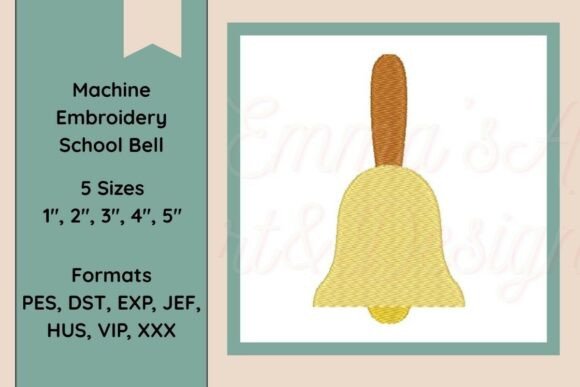
The Machine Embroidery School Bell lands with gentle visual weight—not fussy, not cartoonish, not overly detailed. It reads instantly as “school bell” at 2.5 inches wide, thanks to balanced proportions: a rounded dome, clear clapper, and subtle rope detail rendered mostly in satin stitch with light fill-stitch accents. There’s no tiny text or micro-detailing, which is a relief. That absence of fragile elements means fewer thread breaks, less digitizing guesswork, and better scalability across small hoops (I tested successfully down to a 4” x 4” hoop). It’s a Back To School design that feels handmade—not mass-produced—and that matters when you’re pricing your embroidered tote bags or personalized gifts at $48–$68 on Etsy.
Real-World Stitch Performance: Where It Shines (and Where to Pause)
On stable fabrics like medium-weight cotton canvas (think tote bags, aprons, kitchen towels), the Machine Embroidery School Bell stitched cleanly every time. Satin edges stayed crisp, the clapper held definition, and stitch density felt moderate—not so dense it puckered, not so sparse it looked thin. With proper cutaway stabilizer, even curved surfaces like structured caps held the shape well, though I recommend reducing tension slightly and using a tear-away + cutaway combo for stretchy sweatshirt fleece.
Where caution applies: baby blankets and pillow covers made from brushed polyester or bamboo blends. The design’s smooth curves translate well, but on ultra-soft, low-thread-count fabrics, I saw slight shadowing on dark backgrounds—easily fixed by adding a lightweight topping stabilizer. Also, avoid pairing it with very fine metallic threads; the satin stitch zones are narrow enough that some metallics snagged mid-run. Stick to high-quality 40- or 50-weight rayon or polyester for best results.
No applique design here—this is a fully stitched machine embroidery design. That means no raw edges to fray, no fusible layers to shift during washing. For handmade product longevity—especially items meant for classroom use or daily wear—it’s a practical win.
Commercial Use & Brand Alignment: More Than Just a Theme
If you sell embroidered patches, custom apparel, or boutique merchandise, the Machine Embroidery School Bell quietly elevates perceived value. Its simplicity reads as intentional—not generic. I used it on a linen-cotton blend pillow cover for a teacher-focused Etsy shop, styled it with neutral thread (ecru on navy, charcoal on oat), and paired it with a clean handwritten tagline in mockups. Customers responded strongly to the “thoughtful, not cutesy” vibe—critical when building brand consistency around education, mindfulness, or early childhood.
For printable mockups and social media visuals, it photographs beautifully. No glare from dense fill areas, no fuzzy edges. That translates directly to stronger customer engagement: clearer product shots mean fewer “Is that really embroidered?” questions and faster trust-building. And because it’s compact and scalable, it works equally well on a child’s cap (2.2” version) and a large kitchen towel (3.5” version)—giving you flexible design assets without needing multiple file variants.
Practical Notes Before You Stitch
Before loading the Machine Embroidery School Bell into your embroidery software:
- Always test on scrap fabric—especially if stitching on dark fabric or layered textiles like quilted aprons.
- Check thread color contrast carefully. Light thread on dark fabric can mute the bell’s shape; consider a tone-on-tone approach or a subtle variegated thread for depth.
- Review stitch density in your editing software. While not overly dense, some versions may include optional shadow stitches—disable those if embroidering on delicate baby items.
- Confirm hoop size compatibility. The base file scaled cleanly from 2.1” to 3.8”, but verify your target size fits your smallest working hoop before finalizing a client order.
- Use appropriate stabilizer: medium-weight cutaway for knits, tear-away for stable wovens, and lightweight topping for napped or dark fabrics.
- Inspect small details post-stitch, especially the clapper tip and rope curve—tiny snags or thread nests can hide there on first run.
- Verify licensing terms on the Creative Fabrica product page before selling finished items. This is a digital embroidery file intended for commercial embroidery—confirm whether resale rights apply to your specific use case (e.g., physical products vs. digital bundles).
Final Thought: A Reliable, Repeatable Asset
The Machine Embroidery School Bell isn’t flashy—but it doesn’t need to be. In a market saturated with overdesigned, hard-to-stitch school motifs, its clarity, adaptability, and clean execution make it a dependable workhorse. It fits naturally into teacher appreciation kits, back-to-school gift bundles, and classroom-themed nursery decor—without requiring extra design labor or costly digitizing tweaks.
For craft fair sellers, Etsy shop owners, and small-batch apparel decorators, it’s the kind of embroidery file that earns repeat use: easy to pair with complementary fonts or simple borders, quick to mock up, and trusted to deliver consistent quality. Just remember—the best results come not from the file alone, but from thoughtful prep: the right stabilizer, smart thread choices, and a test run before the customer deadline.